



Risk management entered my life long before I researched it.
I am a mother of two grown-up sons, and if I am honest, motherhood taught me more about risk than any textbook ever could. You learn quickly that control is an illusion, uncertainty is constant, and the real work is noticing signals early, asking difficult questions, and helping others grow without removing responsibility.
That lesson quietly stayed with me.
Professionally, I grew through leadership roles during one of the most uncertain periods in recent history — the global financial crisis — where I was responsible for operational risk systems and business continuity in an international financial environment. It was there that I experienced first-hand the gap between formal risk frameworks and the messy reality of business decisions.
Over the following 10+ years, working across industries as a management consultant, I helped organisations move from silos to synergy — because fragmented organisations struggle not only with execution, but with risk. This work later became part of The Holistic Enterprise, where I explored how organisations function as interconnected systems rather than isolated functions.
My curiosity eventually turned into research.
I earned a PhD exploring how risk management actually happens in organisations — not in frameworks, but in everyday management practice. Through this work, I first defined the distinction between functional and holistic approaches to risk: one treats risk as a separate compliance object, the other sees risk as inseparable from business decisions and organisational reality.
Since then, I have been quietly challenging the mainstream.
Together with the Bank of Lithuania, fintech companies, and the Fintech Hub ecosystem, I co-created a lifecycle-based fintech risk maturity model to answer one practical question:
How can risk management evolve together with business growth instead of becoming a compliance burden?
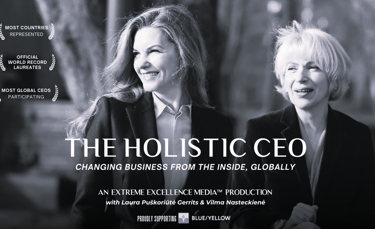
I have also had the privilege of contributing to a world-record initiative together with Laura Gerrits, asking business leaders across countries one deceptively simple question:
How is the world better off because your company exists?
Because risk management, at its core, is not about avoiding problems.
It is about helping organisations survive, adapt, and contribute in a changing world.
Today, through Holistic Business Risk I focus on one mission:
Unfaking risk management - so that risk shapes business decisions before complexity starts shaping them instead.
And yes - these days I split my time between risk maturity and olive maturity in Greece.
Turns out, both teach the same lesson:
You cannot force growth. You can only create the right conditions for it.
My story
Holistically Yours, Vilma Nasteckiene
Risk management entered my life long before I researched it.
I am a mother of two grown-up sons, and if I am honest, motherhood taught me more about risk than any textbook ever could. You learn quickly that control is an illusion, uncertainty is constant, and the real work is noticing signals early, asking difficult questions, and helping others grow without removing responsibility.
That lesson quietly stayed with me.
Professionally, I grew through leadership roles during one of the most uncertain periods in recent history — the global financial crisis — where I was responsible for operational risk systems and business continuity in an international financial environment. It was there that I experienced first-hand the gap between formal risk frameworks and the messy reality of business decisions.
Over the following 10+ years, working across industries as a management consultant, I helped organisations move from silos to synergy — because fragmented organisations struggle not only with execution, but with risk. This work later became part of The Holistic Enterprise, where I explored how organisations function as interconnected systems rather than isolated functions.
My curiosity eventually turned into research.
I earned a PhD exploring how risk management actually happens in organisations — not in frameworks, but in everyday management practice. Through this work, I first defined the distinction between functional and holistic approaches to risk: one treats risk as a separate compliance object, the other sees risk as inseparable from business decisions and organisational reality.
Since then, I have been quietly challenging the mainstream.
Together with the Bank of Lithuania, fintech companies, and the Fintech Hub ecosystem, I co-created a lifecycle-based fintech risk maturity model to answer one practical question:
How can risk management evolve together with business growth instead of becoming a compliance burden?
I have also had the privilege of contributing to a world-record initiative together with Laura Gerrits, asking business leaders across countries one deceptively simple question:
How is the world better off because your company exists?
Because risk management, at its core, is not about avoiding problems.
It is about helping organisations survive, adapt, and contribute in a changing world.
Today, through Holistic Business Risk and the Risk Workout, I focus on one mission:
Unfaking risk management — so that risk shapes business decisions before complexity starts shaping them instead.
And yes — these days I split my time between risk maturity and olive maturity in Greece.
Turns out, both teach the same lesson:
You cannot force growth. You can only create the right conditions for it.
My story
Holistically Yours, Vilma Nasteckiene
Known for
holistic business risk practices
functional vs holistic approaches to risk
lifecycle-based risk maturity
decision-making under uncertainty
business ecosystem facilitation
Risk Workout - a space where CEOs and CROs connect business needs, risk and regulatory boundaries for growth
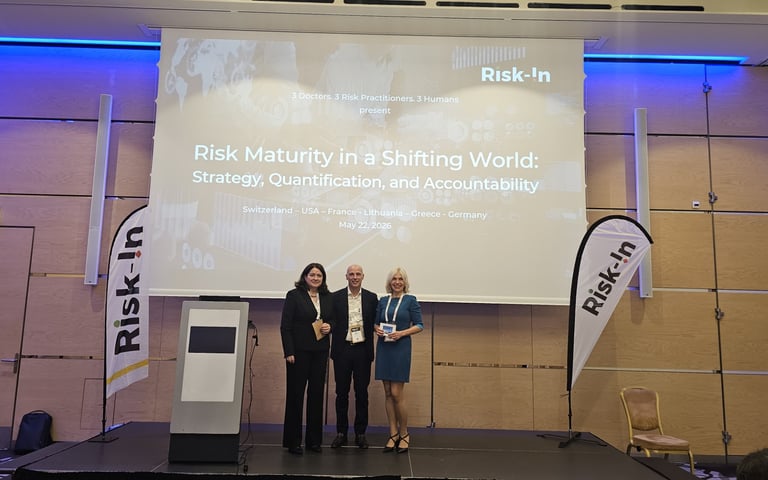
Risk-!n Conference 2026 – Rethinking risk as organisations grow
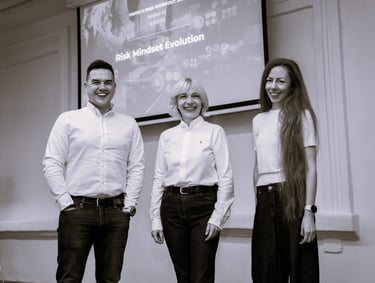
At the international Risk-!n Conference, Dr.Vilma Nasteckienė joined a panel discussion with Dr.Annette Schueller and Dr.Alan Ragueneau, contributing a practice-based perspective on why organisations often lose the ability to act on risk as they scale. Drawing on her research into functional and holistic approaches to risk management, she argued that the real challenge is not identifying risks but keeping what is happening, how it is interpreted, and how decisions are made connected throughout organisational growth. The discussion reinforced her mission: helping organisations make risk shape business decisions rather than merely explain them afterwards.

Self-regulating Fintech: Mission (Im)Possible?

At Risk-!n 2026, Vilma Nasteckiene of Holistic Business Risk shared with The Ingage Institute a refreshing take on regulatory compliance: instead of rushing to write new procedures, organizations should first understand the fear or risk event that triggered a regulation. Most professionals already manage risk through their daily planning and decision-making habits, they simply do not label it as risk management. By converting those existing practices into visible, credible artifacts, teams can satisfy regulators without duplicating effort or creating internal pushback. The key is integration, not addition.
Stop Writing Procedures That Collect Dust: A Holistic Approach to Regulation and Risk Management
Three Questions To Keep Risk Connected to Decisions
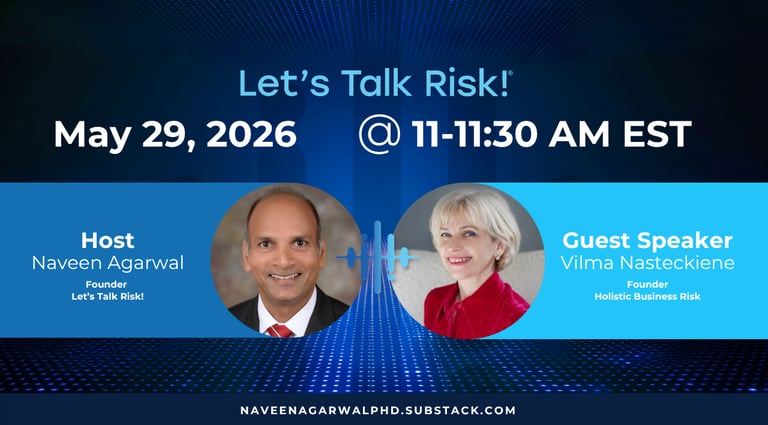
In this Let's Talk Risk! conversation host Naveen Agarwal speaks with Vilma Nasteckiene, PhD, founder of Holistic Business Risk, about a broader and more human view of risk management. This conversation moves beyond medical device risk management in the narrow technical sense. Instead, it explores risk as a business discipline: how companies grow, how complexity creates silos, how risk becomes disconnected from decision-making, and how lifecycle-based risk maturity can help teams move beyond procedures and reconnect risk management with strategy, weak signals, and decision-making.
Continuing the conversation
In European Compliance Professionals Association (ECPA) event Vilma shared the journey and outcomes of the innovation under the initiative of Lietuvos bankas I Bank of Lithuania.
Lifecycle-based Risk Maturity Model was co-created together with all fintech ecosystem to answer one practical question: how can risk management evolve together with business growth instead of becoming a compliance burden? This case is a huge step towards risk leadership and self-regulation in fintech sector.
contact me:
e-mail:
+37068634532 WhatsApp
© 2026. All rights reserved.
let's connect